Overhead Crane Buyers Beware: Runway Design Mistakes Cost Big
menu_open
Content Quick Link
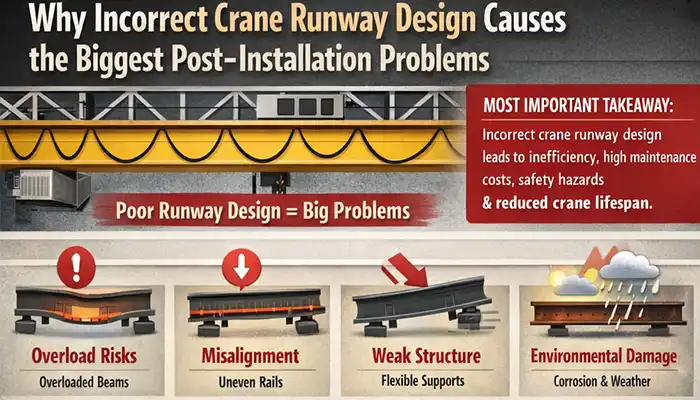
Why Incorrect Crane Runway Design Causes the Biggest Post-Installation Problems
Most Important Takeaway:
Incorrect crane runway design is the leading cause of post-installation issues for overhead cranes. It can result in operational inefficiency, higher maintenance costs, safety hazards, and reduced crane lifespan. Proper runway design upfront protects your investment and ensures long-term reliability.
Key Takeaways
- Overload risks: Ignoring maximum crane loads, dynamic forces, or future capacity upgrades can overload the runway.
- Misalignment issues: Uneven or non-parallel rails cause crane sway, vibrations, and faster wear on wheels and hoists.
- Structural weaknesses: Beams that are too flexible or insufficiently supported compromise lifting precision and safety.
- Environmental factors matter: Temperature changes, weather, and corrosive conditions can damage an improperly designed runway.
- Proactive engineering prevents problems: Early involvement of crane and structural engineers reduces post-installation downtime and costs.
Why Proper Runway Design Is Critical
A crane runway is not just a structural support—it's the backbone of the entire crane system. Think of it as the road your crane travels on. If the road is uneven or weak, the crane can't operate smoothly, no matter how good the hoist or trolley is.
Many buyers focus heavily on the crane itself—lifting capacity, trolley speed, or hoist type—but they underestimate the runway. In reality, most post-installation problems come from runway issues, not the crane. Misaligned rails, weak beams, or incorrect load calculations can lead to:
- Vibrations or swaying during travel that affect lifting accuracy
- Premature wear on wheels, hoists, and rails
- Frequent maintenance and unexpected downtime
- Safety risks for operators and nearby personnel
A well-designed runway ensures safe, stable, and predictable crane operation, reduces maintenance costs, and protects your investment over the long term.
Key Functions of an Overhead Crane Runway
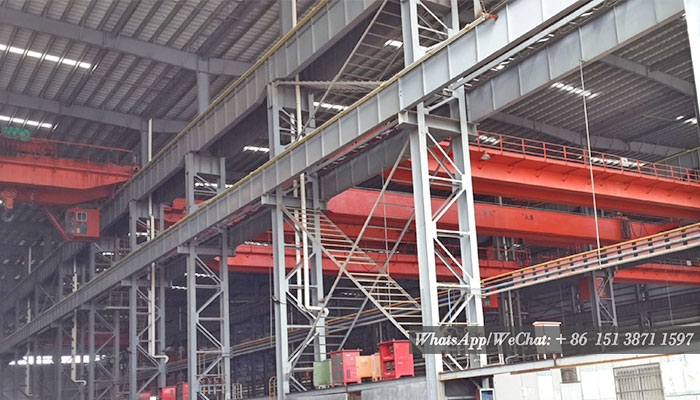 A properly designed runway does more than hold the crane—it allows the crane to operate efficiently and safely under heavy loads. Let's break down the main functions:
Load Support
The overhead crane runway must carry both the crane and its payload safely. This isn't just about static weight; dynamic forces when lifting, stopping, or accelerating can add up. Poorly designed beams or undersized rails may bend or deform, causing misalignment and operational issues.
- Supports crane weight plus maximum payload
- Accounts for dynamic effects like acceleration, deceleration, and sway
- Allows future upgrades or higher capacity without structural failure
Precision Travel
Even a small misalignment in the runway can cause noticeable issues. Cranes can jerk, sway, or skip slightly, which affects lifting accuracy and productivity. Precision travel depends on:
- Level and parallel rails along the entire runway span
- Proper welding, fastening, and alignment of rails to prevent movement over time
- Regular inspections in the early months to catch minor misalignments
Durability
A crane runway must withstand repeated heavy loads for years. Long-term durability requires:
- Sturdy beams and supports that resist deflection and bending
- Materials suited for the environment, including outdoor exposure, humidity, or temperature changes
- Protective coatings if the crane operates in corrosive or outdoor conditions
A durable runway reduces the frequency of repairs and ensures that the crane continues to run smoothly, safely, and efficiently over its lifetime.
Common Runway Design Mistakes
Mistakes in crane runway design are more common than you might think—and they often lead to the most expensive and frustrating post-installation problems. Understanding the most frequent pitfalls can help buyers and engineers avoid costly downtime and safety risks.
Loads and Future Expansion
Many buyers calculate the runway capacity based only on the crane's current maximum load. The problem is that cranes generate dynamic forces during acceleration, deceleration, and lifting. Over time, these forces can stress beams and rails beyond their design limits.
Key Points:
- Runway must support crane weight plus maximum payload, including dynamic forces.
- Plan for future upgrades or higher capacity cranes.
- Ignoring these factors can lead to beam bending, misalignment, and frequent maintenance.
Practical Tip: Always perform a dynamic load analysis and include a safety margin of 20–30% for potential future expansion.
Improper Alignment
Even the strongest runway fails if the rails are not installed correctly. Misalignment can seem minor at first but often worsens over time, causing operational inefficiency and wear.
Key Points:
- Rails that are not level or parallel cause crane sway and vibration.
- Misalignment increases wear on wheels, trolleys, and hoists, shortening lifespan.
- Lifting accuracy and productivity can drop if alignment problems are ignored.
Practical Tip: Use laser alignment tools during installation and perform a recheck after the first few weeks of crane operation.
Insufficient Structural Support
The runway must be strong enough to carry heavy loads without deflection. Weak or flexible beams reduce crane performance and can create safety hazards.
Key Points:
- Weak beams bend under load, causing uneven travel and operational problems.
- Excessive deflection reduces lifting precision and stresses crane components.
- Poor structural support increases accident risks for operators.
Practical Tip: Select steel beams rated for dynamic load plus safety margin, and follow local industrial standards for crane runway structures.
Ignoring Environmental Conditions
Environmental factors are often overlooked during planning, yet they can have a major impact on runway lifespan. Temperature changes, humidity, and corrosive atmospheres can damage even well-designed runways.
Key Points:
- Outdoor runways need expansion joints to manage temperature-driven expansion and contraction.
- Use weatherproof coatings or corrosion-resistant materials in humid or chemical environments.
- Ignoring environmental factors causes premature wear, rust, and structural failure.
Practical Tip: Conduct a site-specific assessment before finalizing materials and design.
Post-Installation Problems from Poor Runway Design
Even a well-chosen crane can underperform if the runway isn't designed properly. Post-installation problems often appear within months and can affect productivity, maintenance, safety, and finances. Understanding these issues helps buyers and plant managers plan preventive measures.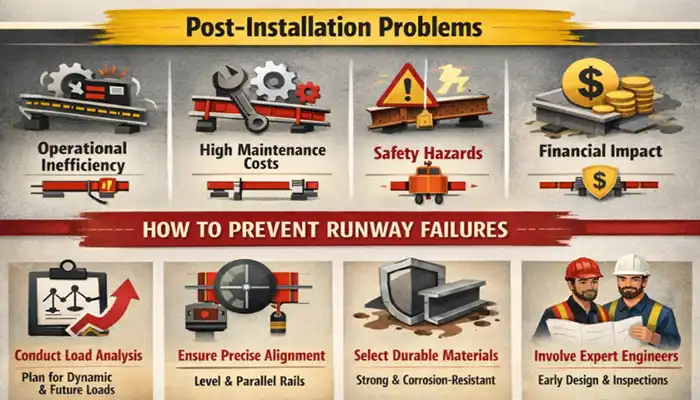
Operational Inefficiency
Runways that are misaligned, flexible, or uneven create vibrations and sway, which slow crane cycles and reduce lifting precision. Small deviations can seem minor but add up over time, affecting daily production.
Key Points:
- Crane travel becomes jerky or uneven, impacting workflow efficiency.
- Lifting accuracy decreases, especially for heavy or delicate loads.
- Production cycles are slower, reducing overall operational output.
Increased Maintenance
A poorly designed runway accelerates wear on all moving parts of the crane, increasing maintenance frequency. Rails, wheels, hoists, and trolleys may require repeated adjustments, repairs, or replacements.
Key Points:
- Misalignment causes uneven wheel and rail wear.
- Frequent adjustments lead to downtime and labor costs.
- Maintenance costs rise over time, often unexpectedly.
Practical Tip: Early inspection and routine maintenance can reduce long-term costs but cannot fully fix underlying runway design issues.
Safety Hazards
Safety risks increase significantly when the runway is weak, misaligned, or improperly supported. Misaligned rails or flexible beams can lead to derailments, tipping, or dropped loads.
Key Points:
- Operator safety is at risk due to unstable crane movement.
- Heavy loads may shift unpredictably during travel.
- Accidents can result in injury, equipment damage, or production stoppages.
Financial Impact
Poor runway design ultimately affects the bottom line. Unexpected repairs, downtime, and reduced crane lifespan increase costs and reduce return on investment (ROI).
Key Points:
- Frequent downtime disrupts production schedules.
- Repair and replacement costs can be substantial.
- A shortened crane lifespan means earlier reinvestment in equipment.
Practical Tip: Investing in proper runway design upfront is far cheaper than dealing with these post-installation costs.
How to Avoid Costly Runway Design Mistakes
A poorly designed runway can turn a well-planned crane installation into a maintenance headache. The good news? Most runway problems are preventable with careful planning, engineering, and early checks. Here's how buyers and plant managers can avoid post-installation issues.
Conduct a Complete Load Analysis
Many runway problems stem from underestimating the loads the system will carry. Dynamic forces—like acceleration, deceleration, and hoisting—add extra stress that static calculations alone don't account for.
Key Steps:
- Include dynamic effects in load calculations.
- Factor in future crane upgrades or increased payloads.
- Build in a 20–30% safety margin to accommodate unexpected stresses.
Long-tail keywords: crane runway load calculation, dynamic load analysis for cranes, future-proof crane runway
Ensure Precise Alignment
Proper alignment is essential for smooth crane travel and reduced wear on wheels and hoists. Even small misalignments can create vibration, sway, and operational inefficiency.
Key Steps:
- Use professional surveying techniques to align rails and beams.
- Check that rails are level, parallel, and straight across the full runway span.
- Recheck alignment after initial crane operation to catch early shifts.
Select Strong, Environment-Suitable Materials
Runway beams and rails must be robust enough to carry heavy loads and durable enough for the environmental conditions they face. Weak materials or unsuitable coatings can lead to deflection, rust, or early failure.
Key Steps:
- Choose steel beams rated for dynamic loads plus safety margins.
- Use corrosion-resistant materials or coatings for humid, chemical, or outdoor environments.
- Consider temperature changes and expansion effects for outdoor installations.
Involve Engineers Early in Design
Engaging crane and structural engineers before installation ensures potential problems are addressed during planning rather than after. Their expertise helps align operational requirements with structural realities.
Key Steps:
- Include engineers in the planning and design phase.
- Verify that runway specifications match crane performance and operational needs.
- Use engineering input to anticipate long-term maintenance and safety issues.
Perform Regular Early Inspections
Even with a strong design, early inspection is key to catching small misalignments or support issues before they become major problems.
Key Steps:
- Inspect rails, beams, and alignment frequently during the first months of operation.
- Check for deflection, wear, or unusual vibration.
- Address small problems immediately to prevent expensive repairs.
Frequently Asked Questions (FAQ) About Overhead Crane Runway Design
Q1: What are the critical functions of an overhead crane runway system?
A properly designed crane runway is more than just a support structure—it ensures smooth, safe, and efficient crane operation. Key functions include:
- Load Support: Carries the crane and its payload safely, including dynamic lifting forces.
- Precision Travel: Maintains proper alignment for stable crane movement and accurate lifting.
- Durability: Resists deformation over repeated heavy loads, ensuring long-term reliability and reducing maintenance needs.
Q2: Which design mistakes lead to operational and safety problems?
Common runway design errors often cause the most post-installation headaches:
- Underestimating Loads: Ignoring dynamic forces or future upgrades can overload the runway.
- Improper Alignment: Rails that are uneven or non-parallel cause sway, vibration, and accelerated wear.
- Insufficient Structural Support: Weak or flexible beams reduce lifting accuracy and compromise safety.
- Ignoring Environmental Factors: Outdoor exposure, temperature changes, or corrosive conditions can damage materials and lead to structural failure.
Q3: How do poorly designed runways impact maintenance, productivity, and cost?
A bad runway design creates problems across operations, safety, and finances:
- Operational Inefficiency: Vibrations, sway, and uneven travel slow crane cycles and reduce productivity.
- Increased Maintenance: Rails, wheels, and hoists wear faster, requiring frequent repairs or replacements.
- Safety Hazards: Misaligned or weak runways increase derailment risk and endanger operators.
- Financial Impact: Unexpected downtime, repairs, and reduced crane lifespan lower ROI and increase long-term costs.
Q4: What steps can buyers, engineers, and plant managers take to avoid these issues?
Preventing runway problems starts during planning and continues through early operation:
- Conduct Load Analysis: Include dynamic forces and future upgrades, with a safety margin.
- Ensure Precise Alignment: Use professional surveying techniques and laser tools for level and parallel rails.
- Select Strong, Environment-Suitable Materials: Steel beams and corrosion-resistant coatings are essential for durability.
- Engage Engineers Early: Crane and structural engineers can catch issues before installation.
- Perform Regular Inspections: Check alignment, deflection, and wear during the first months of operation.
Conclusion: Why Runway Design Should Never Be Overlooked
A crane runway is more than a structural support—it's the foundation of safe, reliable, and efficient crane operation. Most problems that appear after installation, like sway, vibrations, or frequent maintenance, are caused by poor runway design rather than the crane itself.
Ignoring runway design may seem like a small cost-saving measure upfront, but it can lead to major downtime, repair expenses, and safety risks later.
Key Takeaways
- Runway design directly affects crane performance, precision, and lifespan.
- Misaligned or weak runways increase maintenance needs and operational inefficiency.
- Environmental factors and load miscalculations can cause premature structural failure.
Action Steps for Buyers and Plant Managers
- Treat runway design with the same priority as the crane itself.
- Invest in accurate load analysis, alignment checks, and structural engineering expertise upfront.
- Choose durable materials and environment-suitable components to ensure longevity.
- Implement regular inspections during early operation to catch minor issues before they escalate.
A properly planned runway is not just a structure—it's a strategic investment in:
- Smooth and efficient crane operation
- Operator safety and workplace reliability
- Long-term cost savings and maximum ROI

Article by Bella ,who has been in the hoist and crane field since 2016. Bella provides overhead crane & gantry crane consultation services for clients who need a customized overhead travelling crane solution.Contact her to get free consultation.